
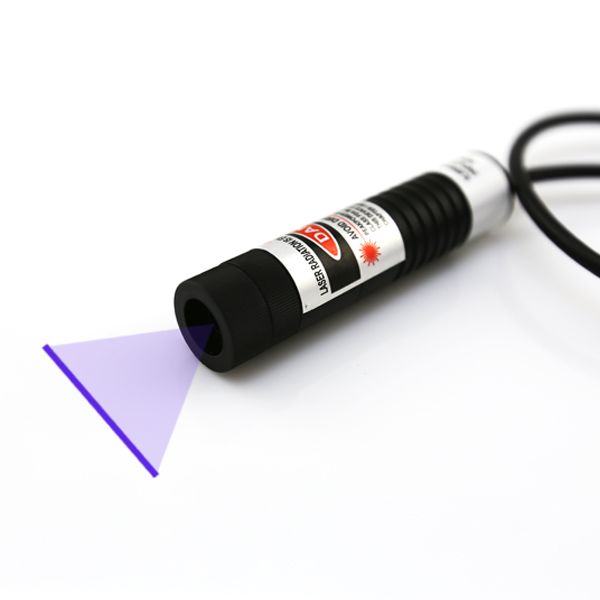
Unlike the use of other visible laser devices, the adoption of a violet laser line generator applies a shorter wavelength of 405nm, which is a classic fluorescence excitation band, efficiently exciting commonly used probes and labels. The photon energy is moderate, suitable for weak signal detection and imaging experiments. Being made with an import 405nm violet laser diode and a qualified optic lens inside a different dimension metal housing tube, only after its easy connects with DC power supply and proper equipment with scientific research used machine or equipment, violet laser module enables good direction, high precision and high brightness violet reference line projection onto multiple experimental work fields conveniently.
405nm violet laser line generator mainly undertakes functions such as fluorescence excitation, precision measurement, micro-nano observation, photochemical irradiation, and optical calibration in scientific experiments. It always gets wide range output power of 50mW to 100mW and higher power up to 150mW to 500mW, equipped with a qualified glass coated lens or separate crystal lens within 10 to 110 degree fan angles. It can easily maintain ultra fine, straight and fine violet reference line projection within 0.5 meter to 6 meters length. Cooperated with adjustable focus optic lens, when violet line laser module gets highly concentration violet laser light emission, it converts into an increasing brightness and fineness violet line. The violet laser line covers the test area in one pass, faster and more efficient than point laser scanning, resulting in good consistency of experimental data.
Compared with otehr visible laser devices, 405nm violet laser line generator gets shorter wavelength than red and infrared light, with a smaller diffraction limit and higher resolution, suitable for micro/nano-scale observation, fine structure resolution, and detection of tiny defects and particles. Equipped with APC, ACC driving circuit board, whatever output power it is selected, it keeps work with stable output mode, small divergence angle, highly straight and sharp edge violet laser line projection, facilitating the construction of precision optical systems and ensuring reliable calibration and measurement results. Featured by small size and low power consumption, after easy integration with self made experimental devices, optical platforms, and detection equipment, 405nm violet alignment laser is applicable for long term continuous experiment with strong stability and research laboratories. It has also become a commonly used light source for basic research and precision experiments in fields such as biology, materials, chemistry, and physics.
Applications in scientific research fields:
The 405nm violet laser line generator is mainly used as a precision light source for experiments such as detection, excitation, calibration, imaging, and interference. It is widely used in basic and applied research in physics, chemistry, biology, materials science, and optics.
1. Fluorescence Spectroscopy and Microscopic Imaging Experiments
As a fluorescence excitation source, it excites fluorescent proteins, quantum dots, organic dyes, and fluorescent probes.
The single-line spot is used for line-scan fluorescence imaging, enabling rapid two-dimensional cross-sectional imaging and improving imaging speed and throughput.
2. Optical Measurement and Precision Calibration Experiments. The single-line violet alignment laser is used as a calibration benchmark for straightness, flatness, angle, and displacement.
3. Surface morphology and thickness measurement of micro/nanostructures, gratings, thin films, and transparent materials.
4. Microfluidics and micro/nano manipulation experiments: Droplet detection, interface monitoring, channel localization, and flow velocity analysis in microfluidic chips.
5. Materials science and photochemistry experiments: Region-selective excitation of photocatalysis, photopolymerization, photodegradation, and photocuring reactions.
6. Physical optics and laser fundamental experiments: Wave optics experiments including interference, diffraction, scattering, and polarization.
